会痛的十七岁
Leading early, Machado claims win in Venezuelan opposition’s presidential primary_我的网站

一 | CARACAS, Venezuela -- Early returns in the Venezuelan opposition's presidential primary gave a big lead to former legislator Maria Corina Machado early Monday, and she quickly claimed victory as the voters' choice to lead the campaign to end the decade-long, crisis-ridden presidency of Nicolás Maduro. The independent National Primary Commission, which organized the primary, did not release any results until long after polling stations closed Sunday, blaming internet censorship. The organizers said that in the first 601,110 ballots counted, about 93% picked Machado, who had entered the vote as a strong front-runner. The rest of the votes were scattered among the other nine candidates. There was no indication of how many people cast ballots in all, and organizers were expected to release additional results throughout Monday.“Today, very powerful forces have been unleashed," Machado told supporters gathered outside her campaign headquarters in the capital, Caracas. “Today, we have shown ourselves what we are capable of doing in the face of all the obstacles, in the face of all the abuses.”Holding Venezuela’s first presidential primary since 2012 required the deeply fractured opposition to work together. Venezuelans, in turn, showed up at voting centers in and outside of their homeland to make it count, enthusiastically lining up for hours despite scorching sun and torrential rain.Still, what they saw as a monumental exercise in democracy could still prove futile, if Maduro’s government wishes.While the administration agreed in principle to let the opposition choose its candidate for the 2024 presidential election, it also has already barred Machado from running for office. Maduro’s government has in the past bent the law, retaliated against opponents and breached agreements as it sees fit.Hundreds of people gathered at voting centers in neighborhoods across Caracas even before polls opened. They stayed in line despite a rainstorm that left them soaking wet. They carried umbrellas, folding stools and coffee to ease the expected waits, and leaned against buildings or stood under marquees to try to avoid the rain. Caracas resident Stephanie Aguilar, 34, cried while she waited to vote. She described the primary as the only “salvation” for her country, her daughter and son, and the millions of Venezuelans who decided they had to emigrate due to the nation’s economic and political turmoil. “We want a better country, a free country, for my children ... who have grown up in this government,” Aguilar, a housewife, said as she wiped tears from her face. “They ask, ‘Mom, can we go out to eat?’ No, there is no money. ‘Mom, can we do this thing?’ No, there is no money. It is unfortunate that a society grows up under those conditions.”Venezuelans typically vote at public schools, but the independent commission that oversaw the primary opted to use homes, churches, private schools and other facilities after electoral authorities did not respond to requests for help in a timely manner.Jesús María Casal, head of the National Primary Commission, blamed the hours-long delay in issuing election results on internet restrictions. “Once we began the process of counting the results ... we detected that our server that functioned as a transmission channel was blocked, which prevents us from completing this process as scheduled,” he said.The London-based internet monitoring firm NetBlocks tweeted metrics showing “a disruption to internet connectivity in #Venezuela with high impact to Caracas." It added that a state-owned internet service provider claimed “an issue with its energy backup system.”David Smilde, an expert on Venezuelan politics at Tulane University, said the primary was a “significant achievement” for several reasons, including forcing political leaders and parties within the opposition “to reach out and speak to the people.”“And it has generated considerable enthusiasm and mobilization in a population that has been skeptical of the opposition leadership of late,” he said.Machado, a proponent of free-market economic policies, is a longtime critic of the governing United Socialist Party of Venezuela. She maintained a somewhat low profile for years but dominated the primary campaign by connecting with the same voters she consistently urged to boycott previous elections.The presidential election is expected to be scheduled for the second half of 2024. Maduro is looking to extend his presidency until 2030, which would surpass the time that Hugo Chávez, his mentor, governed and established his self-described socialist policies.Maduro’s allies ridiculed and dismissed the primary all year. Still, both the government and its opponents used the contest as a bargaining chip to extract concessions from each other as part of a negotiation process meant to end the country’s complex social, economic and political crisis. Maduro and an opposition faction backed by the U.S. government last week agreed to work together on basic conditions for the presidential contest. That prompted the government to release six political prisoners and the Biden administration to lift key economic sanctions. As part of the agreement, Maduro’s administration and the opposition are supposed to “recognize and respect the right of each political actor to select” a presidential candidate freely.If organizers declare Machado the primary's winner, the focus will shift to Maduro to see if the government reverses its ban on her seeking public office. In June, the government issued an administrative decision prohibiting Machado from running, alleging fraud and tax violations and accusing her of seeking the economic sanctions the U.S. imposed on Venezuela in the last decade. The U.S., holding up the threat of renewed sanctions, has given Venezuela until the end of November to establish a process for reinstating all candidates expeditiously.A U.N.-backed panel investigating human rights abuses in Venezuela said last month that Maduro’s government has intensified efforts to curtail democratic freedoms ahead of the 2024 election. That includes subjecting some politicians and other opponents to detention, surveillance, threats, defamatory campaigns and arbitrary criminal proceedings.All registered voters in Venezuela were allowed to participate in the primary, as well as tens of thousands living in several other countries.“This is unprecedented,” said a smiling María de los Ángeles León, 31, the coordinator of Mexico City’s voting site. “People know that we have no guarantees that the winner of this election will be able to advance to the presidential election, but we keep trying.”___Associated Press writer María Verza in Mexico City contributed to this report.。
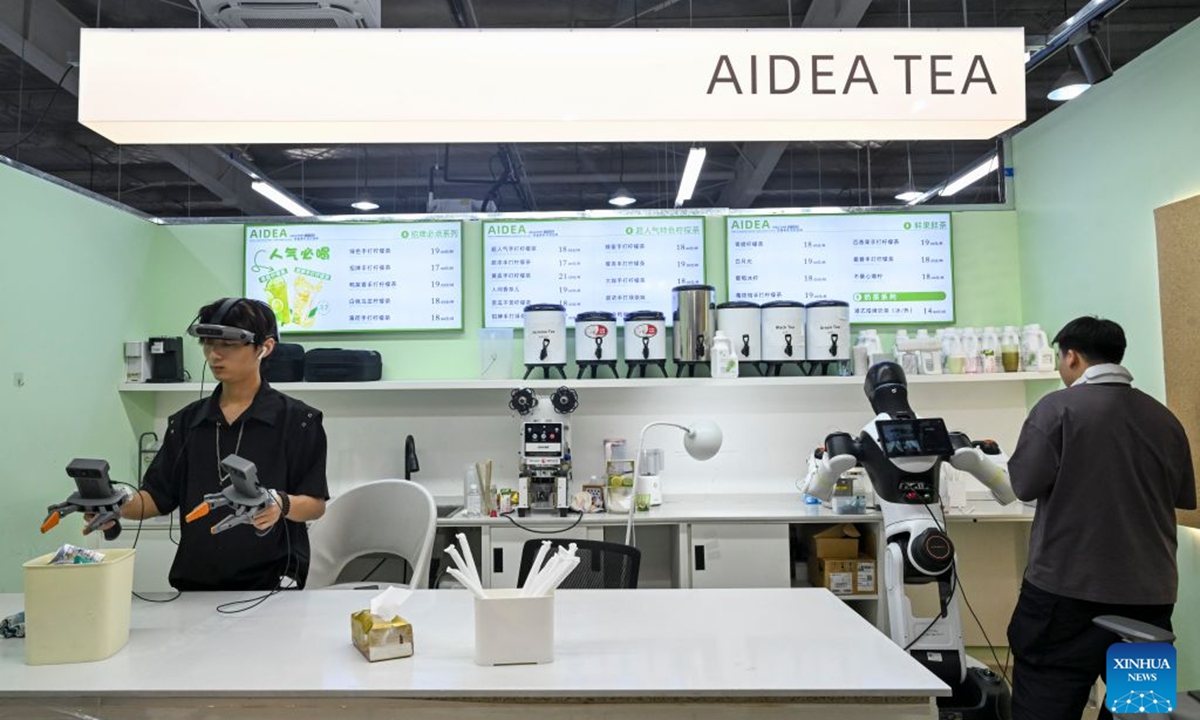
Staff members train a robot to work in a retail scenario at Maniformer, a physical AI data service platform, in Shanghai, east China, Aug. 5, 2026. In Shanghai's tech companies like AGIBOT and Maniformer, embodied intelligence robots are trained in household, retail, sorting, production and other real-world scenarios, to advance their AI capabilities for real-life use. (Xinhua/Chen Haoming)
Nation's value added in the service sector grew 5.2 percent year-on-year, 0.5 percentage points faster than overall economic growth. Retail sales of services rose 5.3 percent year-on-year. In the first half of the year, the service sector expanded steadily, playing an important role in supporting industrial upgrading and meeting people's livelihood needs.
A meeting of the Political Bureau of the Communist Party of China (CPC) Central Committee held on July 30 called for effectively expanding domestic demand and optimizing supply.
From April 7 to 8, a national conference on the service sector was held in Beijing — the first national gathering in the new era devoted to the service sector.
General Secretary Xi Jinping called for advancing producer services toward greater specialization and the higher end of the value chain, fostering high-quality, diverse and accessible consumer services, and building more "China Services" brands, as well as striving to break new ground in the high-quality development of China's service sector.
Beijing convened a municipal service sector conference and pledged to actively shape the "Beijing Services" brand.
Shanghai released its 15th Five-Year Plan (2026-30) for service sector development, aiming to comprehensively enhance the global reach and international competitiveness of "Shanghai Services."
Southwest China's Chongqing Municipality set out to build a modern service industry system and burnish "golden calling cards" of service development such as "Chongqing Trade Global."
Since the national conference, regions and departments have coordinated their planning and accelerated the building of service brands. By 2030, China's service sector is expected to top 100 trillion yuan ($14.6 trillion) in total scale, with higher quality, a better structure and improved standards.
With that target in sight, the Chinese economy is undergoing a fresh "system upgrade."
IBuilding more "China Services" brands is an inevitable choice that follows the laws of economic development and drives economic transformation and upgrading.
China's service sector has steadily expanded in scale and continuously improved in quality and efficiency since the 18th National Congress of the CPC, playing an important role in supporting industrial upgrading, meeting people's livelihood needs and driving job growth, according to Xi.
Scale is the most direct yardstick. In the first half of this year, the service sector accounted for 59.5 percent of GDP, making it the largest sector of the national economy, and contributed 66.1 percent to economic growth, emerging as the main engine of expansion. The figures reflect the sector's weight in high-quality development and in Chinese modernization as a whole.
The Chinese economy sits at a critical window as it shifts from factor-driven to innovation-driven growth, and from investment-led to consumption-led expansion. Projections show that during the 15th Five-Year Plan period, the service sector's contribution to GDP growth will rise steadily, making it the economy's main engine in every sense.
This is also where the key lies in answering people's expectations for a better life and in expanding domestic demand.
The changing Engel coefficient traces the leap in household consumption. At the start of reform and opening-up, the Engel coefficient for Chinese households exceeded 60 percent; in 2025 it stood at just 29.3 percent. The sharp drop in the share of spending on food has freed up vast room for consumption of services such as education, health, culture and tourism.
Global experience shows that once a country's per capita GDP passes $10,000, its consumption structure typically shifts markedly, with services taking a rapidly rising share. China is now in that critical transition. Consumption is moving from "subsistence consumption," geared mainly to basic needs, toward "development-oriented consumption" that seeks quality, experience and self-fulfilment.
From the breakout popularity of the Jiangsu Football City League and the Village Super League to the growing craze for "traveling to catch a show"; from the rapid spread of service points for the elderly and young children to 30-minute delivery of just about anything becoming the norm — service consumption is no longer an optional garnish but a necessity of a better life. With a middle-income group of more than 400 million, China is entering a golden period for expanding the capacity and quality of its service sector.
It is also a key step toward raising total factor productivity and developing new quality productive forces.
Take a garment company. In R&D, AI-assisted design can shorten development cycles. In production, intelligent transformation and digital upgrading can sharply lift efficiency. In distribution, modern logistics can cut overall costs. In sales, market analytics can match products precisely to customer segments.
Globally, as industries divide labor more deeply and integrate faster, leading manufacturers are broadly shifting toward service-oriented manufacturing, drawing on strengths in information, finance, R&D and design to dominate the construction of global value chains. Producer services play an increasingly prominent role in production networks, and largely determine whether product value can extend toward both ends of the "smile curve."
As the world's largest manufacturing nation, China still sees producer services account for less than 35 percent of GDP in value added, leaving gaps in scale, quality and efficiency compared with advanced international levels. Upgrading the service sector is key to moving from a manufacturer of quantity to one of quality.
IIIn building more "China Services" brands, tailoring measures to local conditions and applying targeted policies is the basic methodology.
Underscoring demand-driven development, reform breakthroughs, technology empowerment as well as opening-up and cooperation, Xi called for carrying out capacity-expanding and quality-upgrading initiatives in the service sector.
The service sector spans many categories and takes many forms; its subsectors differ in their levels of development and the challenges they face.
Start with producer services, these must serve enterprises across the full span of production and operations, with the aim of firmly supporting industrial transformation and upgrading by shoring up weak links along the entire chain.
Among these, the deep integration of advanced manufacturing and modern services — the so-called integration of the two sectors — is one of the core propositions of current industrial policy. For a long time, manufacturing and services have operated on parallel tracks, belonging to different policy systems, statistical classifications and regulatory frameworks.
Breaking down this divide requires embedding services into every pore of manufacturing, and the breakthrough lies in data and policy. On one hand, the industrial internet should serve as the link that connects data silos, drawing service firms to develop specialized, manufacturing-oriented services on a data foundation and forming an ecosystem of "data flow — embedded services — value creation." On the other, statistical and policy systems need reform: drawing on international experience, service units inside manufacturers should be able to keep separate accounts and enjoy service-sector policy benefits, giving the integration of the two sectors a clear policy foothold.
Turn to consumer services. At their core, these address people's needs across the full life cycle, with the aim of better meeting aspirations for a better life by raising the development level of key consumer service areas.
Take elderly care and childcare. Demand is moving up from basic provision toward inclusive and even mid- to high-end services, and it is broadening: expectations now span facilities, services, and material and emotional needs alike. Supply-side structural strains are equally acute. In some big cities, beds at high-quality elderly care institutions are nearly impossible to secure, while many beds sit empty at township homes for the elderly. Places at standardized chain childcare centers are hard to come by, even as some small childcare providers struggle to stay in business.
Faced with strains that are multilayered and varied, only precise disaggregation and tiered policies can deliver genuine quality upgrades.
At the baseline, the government should take the lead in improving the three-tier elderly care network across counties, townships and villages, reinforcing the social safety net. At the middle tier, the government should guide the way — using investment, tax and fee incentives, resource guarantees and institutional reform to mobilize more social forces, so that more families can access elderly care and childcare that is affordable, reliable in quality and safe. At the upper tier, industrial policy and a better business environment should support market players in providing personalized and customized services.
IIIBuilding more "China Services" brands means seizing the initiative through the newness of innovation and winning reputation through the substance of quality.
Building more "China Services" brands requires deepening institutional opening-up.
Brands are forged only in open competition. However, barriers in goods trade sit mainly "at the border" — tariffs and customs clearance — while barriers in services trade are more often hidden "behind the border," in market access rules, regulatory systems, qualification recognition and the mutual recognition of professional credentials.
China needs to keep refining the negative list for the service sector and further trim its scope, so that it becomes a genuinely predictable and workable opening-up commitment. It also needs to improve regulatory transparency and consistency, align regulatory rules with prevailing international practice, and reduce hidden barriers. At the same time, cross-border mutual recognition of professional credentials for engineers, physicians and others should be actively advanced, allowing high-end service talent to move freely.
Building more "China Services" brands also means that, as the saying goes, it takes a good blacksmith to forge good iron.
A recent piece of news drew global attention: Mixue Ice Cream & Tea has grown to nearly 60,000 stores worldwide, becoming a food and beverage chain of broad global influence.
Behind Mixue's success lies an intelligent supply chain system. At the front end, it converts consumption data into planting data, guiding farmers to produce to order. In the middle, an intelligent scheduling system coordinates nearly 30 warehouses nationwide, with cold chain coverage reaching more than 97 percent of stores. At the tail end, algorithms provide precise support for choosing store locations. Foreign media have remarked that the chain store's mascot "Snow King" will turn up in your city sooner or later.
Differentiated competition among service brands, in the end, comes down to a contest of innovation capability. For "China Services" brands to truly stand firm, make a name and travel far, they must seize the initiative through the newness of innovation, pushing continuous breakthroughs in service models, technologies and consumption scenarios, and win reputation through the substance of quality.
From selling products to selling services, from "Made in China" to "China Services" — as a 100-trillion-yuan service landscape slowly unfolds, there is reason to believe that these gleaming "China Services" calling cards will converge into powerful momentum for the high-quality development of the Chinese economy.
This was compiled from an article originally published on the front page of the People's Daily on August 13, 2026. 。

二 |
Current article:http://ybi0ap.mexuanmeixuyaopinzheng.shop/j35/3fkqkez.html
Published on:17:51:24


